温孝福Wen Xiaofu
2025-12-23 09:36:18 Art weekly
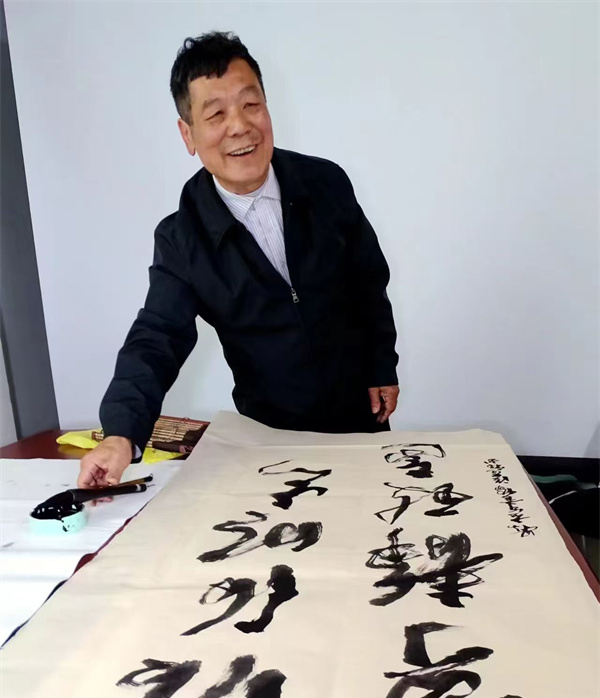
Wen Xiaofu, male, born in 1952, holds a university degree and is a senior high school teacher. I loved calligraphy during my student days and once wrote calligraphy by Huang Ziyuan; After starting work, I tend to focus on running script in my spare time, such as Mao Zedong's poetry. More than ten years ago, the "Chinese Calligraphy and Painting Guide" held a seminar, and submitted and participated multiple times. National level elites personally demonstrated their calligraphy skills and gained insight into rare techniques. Subsequently, I joined the correspondence tutoring program of the newspaper and saw immediate results with Lin Erwang, Zhao, Ou, Mi Tie, and others. In recent years, I have participated in "Jixiang" online learning and once again received guidance from many masters. Admiring ancient masters for their simplicity and elegance, and admiring contemporary masters for their antiquity and uniqueness. I feel ashamed of being dull and have made little progress in studying several types of books. The work won county and city awards and was included in the collection of works. Has obtained the certificate of "National Third level Book Master". With a love for calligraphy, a passion for inheriting Chinese culture, adapting to social needs, writing about current affairs, congratulating happy events, creating a cultural atmosphere, and writing couplets, plaques, and screens for temples, halls, and rooms... My love and dedication to calligraphy will still be with health.
Elegant and graceful, expressing one's emotions
——Impressions of Wen Xiaofu's Calligraphy
Huang Jinliang (Editor in Chief of Chinese Painting and Calligraphy Guide)
Wen Xiaofu's running script is based on the two Wangs and integrates the Mount Huangshan Valley's interest. Its structure reflects the positive and the negative. Its composition is "vertical with lines, horizontal without lines", such as the comment in "Book Manual" that "breaking is more and more complete, and confusion is more and more governance". The small characters in the title also demonstrate skill, with precise yet elegant strokes that blend seamlessly with the main style of the book, creating a harmonious blend of hardness and softness.
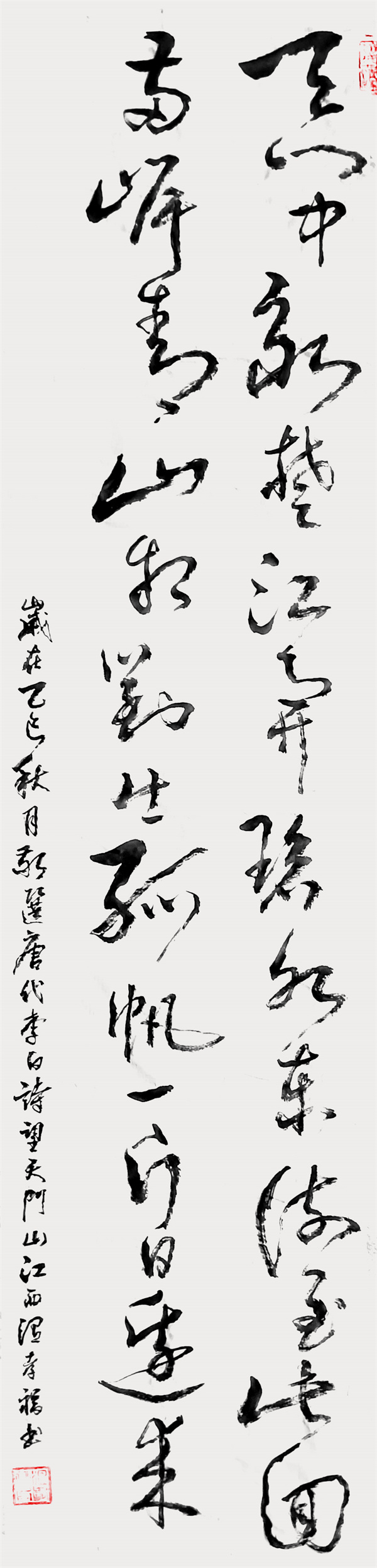
Looking at his cursive script 'Viewing Tianmen Mountain', the brushwork is as described in Sun Guoting's' Shupu ':' The wind spirit is used to make it cool, and the beauty is used to warm it up ': the lines are dry and smooth, combining the power of' being calm and happy 'with the softness of' leisurely and elegant '. The starting and ending points show the laws of the Jin and Tang dynasties, revealing the elegance of the Ming and Qing dynasties.
The most touching thing is his book's expression of emotions: the grandeur of Li Bai's poetry is transformed into ink colored ups and downs and surging lines in his writing, just as Sun Guoting said, "forming its sadness and music". Whether it is the opening of large characters or the collection of small characters, they are all based on the principle of "heart, hand, and emotion". They not only adhere to the "form and quality" of ancient methods, but also develop the "temperament" of modern people, living out a traditional new posture in the contemporary calligraphy world.


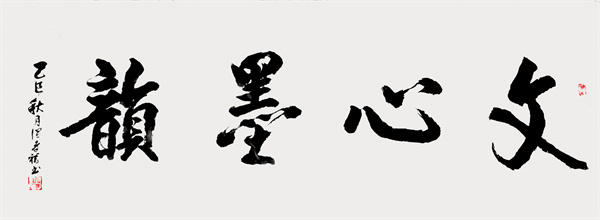
Copyright Notice: Original content on this website is welcome to be reposted. Please indicate the source when reposting, Global Art Network www.caanets.com; Some of the content posted on this website comes from the internet. If there is any infringement, please contact this website to delete it.
Daily recommendations
- [Exhibition]Sketching Public Education ...
- [News]Russian Avant garde Art Exhibition
- [News]Stone Tiger's Last Ten Yea...
Weekly hot topics
- 1Tianyu Ballad showcases the ...
- 2Wu Shanming Chinese Brush In...
- 3Three calligraphers go to Pi...
- 4Kunyun Danqing · Yongkun Op...
- 5The Art Exhibition of 'Circu...