My Opinion on Renaming 'Chaotic Books' to' Yushu '
2025-10-25 21:01:50 The Royal Water Law
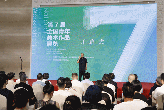
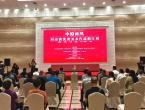
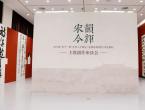
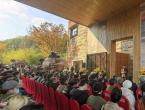
On October 4th, by the banks of the Xiang River. Several calligraphers and critics have engaged in a dialogue spanning time and space, focusing on the theme of upholding the principles of calligraphy and innovation.
Mr. Wang Dongling, a famous artist, was on site and wrote a book about the Tang Dynasty poet Bai Juyi's line "A thousand miles from the beginning, a tiny speck of dust rises from a high mountain". When the "momentum" of cursive script breaks free from the shackles of form, and when the lifting and turning points form new rhythms in superposition, "chaotic writing" has become the most radical extension of classical cursive script in contemporary times.
The author witnessed this art event on site, which also sparked some thoughts about 'chaotic books'.
The "chaotic book" created by Mr. Wang Dongling is like a stone thrown into the contemporary calligraphy world, stirring up ripples in the "sea of ink": innovators praise it for breaking the deadlock, saying that it has activated the organic life of ancient lines; Those who uphold righteousness worry about losing their roots and condemn it as a frenzy of losing control of their writing.
The root cause of this debate is certainly complex, but the word 'chaos' in' chaotic books' undoubtedly played a role in fueling it. The word 'chaos' naturally carries negative associations of' chaos', 'nonsense', and 'disorganization', which can easily lead people to have preconceptions and view it as a departure from tradition and destruction.
Therefore, the author suggests renaming "chaotic books" to "Yu Shu". This easy word is not a simple word game, but a crucial "name correction". It aims to sweep away the illusions of appearances and directly reach the core of art, which has profound constructive significance in dispelling misunderstandings in society and academia.
The word 'Yu' carries a profound meaning, sweeping away the shadow of chaos and displaying a majestic atmosphere
One is the dominant force. 'Yu' is control, driving, and contains unquestionable control. It accurately reveals the artist's absolute dominance over tools, nature, and organization under the wild brush and ink.
The second is the structure of space. 'Yu' is an arrangement, a layout that vividly reveals the unique technique of skillfully manipulating lines and shapes in a two-dimensional plane, thus constructing a profound visual space.
The third is the maintenance of order. 'Yu' has laws and latitude, implying that although thousands of strokes and paintings intertwine and stack in the work, its internal skeleton and logic are orderly, like a military formation.
The fourth is the realm of freedom. 'Yu' is the calmness after mastery, and the exploration above the Dharma. It reflects the artist's ultimate freedom of transcending rules and having a smooth mind and hand after deeply understanding tradition.
What is' Yu Shu '? Yushu is a highest level of writing that involves using meaning to control the pen, using the pen to control the lines, interweaving the lines and creating a cohesive atmosphere.
From a visual perspective, the final presentation of 'Yushu' is like a magnificent 'brush and ink army formation'. It inherits the spirit of the "ink accumulation method" advocated by the Chinese painting master Huang Binhong, and through the layering, infiltration, and blending of brushstrokes, the ink color and lines radiate endless thickness, splendor, and layers in accumulation. The lines thus broke free from the constraints of the plane and transformed into a three-dimensional structure with volume, concealment, and life, composing a "visual symphonic poem".
From the perspective of inner charm, the brilliance of 'governing books' lies in' governing and legitimizing '. This method is reflected in three realms: firstly, the technique of brushstrokes, where each stroke's beginning, ending, and turning are intertwined, but the strokes are broken and the meaning is connected, resulting in a continuous flow of qi; The second method of character construction, in the ultimate deconstruction, the ancient souls of oracle bones and seal script are still hidden as "roots" and "gods", and can be traced back as grass snakes and gray lines; The third is the method of space, which manages the breathing rhythm and rhythm of "dense but not breathable, sparse but movable" through the concentration and dispersion of ink colors and lines.
The name 'Yu Shu' is a sublimation of 'chaotic books'. The 'chaotic book' is only a superficial depiction, while 'governing the book' is a revelation of essence and an aesthetic justification, perfectly interpreting the supreme concept of 'keeping roots and opening hearts' that upholds integrity and innovation.
The so-called 'root' here refers to the genes of Chinese characters. Under the seemingly unrestrained brushwork of "Yu Shu", there is a deep cultivation of the essence of calligraphy techniques (such as house leak marks and cone painting sand) and aesthetic spirit accumulated over thousands of years. It never deviates from the structural essence of Chinese characters, but explores and expresses the ultimate artistic tension within them.
The so-called 'heart' here refers to the contemporary soul. Yushu "adopts the most open attitude, integrating elements of modern abstract art, constructivism, and even performance art. It completely liberates writing from the function of "reading" and emphasizes the instantaneous emotional outburst, physical movement trajectory, and pure visual power, allowing ancient calligraphy art to resonate with contemporary life experiences. It can be said that 'Yushu' is a modern expression of traditional spirit, a relaxed stroke of heavy text, and a contemporary face of elegant art.
In summary, those who control books also control skills. It is not a chaotic carnival, but a "brush and ink manipulation" full of rational construction and life passion. Artists are like skilled masters, crossing the traditional battlefield and opening up a new realm of calligraphy art with the deepest control.
This is precisely the profound value of "governing calligraphy": it not only holds the "roots" of calligraphy, but also opens up the "heart" of art.
(The author is the Vice President and Secretary General of Lanting Calligraphy Society)
Copyright Notice: Original content on this website is welcome to be reposted. Please indicate the source when reposting, Global Art Network www.caanets.com; Some of the content posted on this website comes from the internet. If there is any infringement, please contact this website to delete it.